
Should You Rent or Buy Your Office Photocopier?
I have been in the office equipment trade for more than twenty years, and the one question I hear more than any other is whether it makes sense to buy a photocopier or rent one instead. People expect a quick answer, but the truth is it depends on your business and how you use print.
The good news is that once you lay the numbers out side by side, the decision gets a lot clearer. In this guide I will take you through the real cost of buying, the real cost of renting, and the situations where each one makes sense, all in plain English and without the sales patter.
By the end you should know exactly which route fits your business, and why.
What Buying a Photocopier Actually Costs
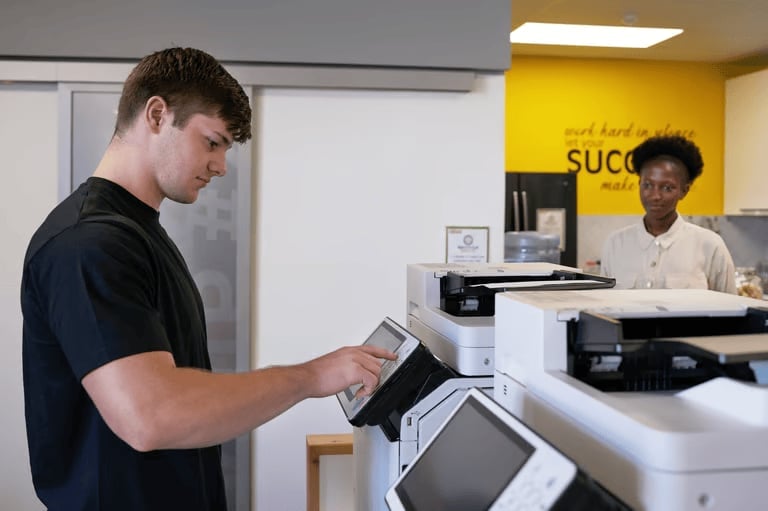
A modern office photocopier can look simple enough, but the paperwork behind it rarely is.
The sticker price is only the beginning. A decent freestanding office photocopier will usually set you back somewhere between £3,000 and £15,000 depending on how fast it is and what it can do. For a business buying that machine outright, that is a sizeable chunk of money leaving the account in one go.
On top of that, the machine becomes yours to look after. Toner, drums, fuser units, and replacement parts all sit on your bill rather than anybody else's. A single toner cartridge for a larger machine can cost £150 or more, and an engineer's visit to fix a fault will rarely come in under £90 an hour. If the machine goes down, your productivity goes down with it while you wait for someone to come and look at it.
Buying also ties up capital that could be earning its keep elsewhere in the business. Photocopiers do not hold their value, so in three or four years you will be left with a machine worth a fraction of what you paid for it, and the newer models will have moved on without you.
What Renting a Photocopier Actually Costs
With a photocopier rental, you pay a simple monthly fee that covers the machine, the servicing, and usually the toner too. There is no large payment up front, and no surprise engineer's bill when something stops working, because the supplier is the one on the hook to keep it running.
That monthly figure will look higher on paper than a lease spread out over five years, but it is worth comparing what each one actually includes before you judge it. A rental bundles the upkeep into one predictable payment, so you always know what is leaving your account each month.
The other thing to remember is flexibility. If your business changes, your rental can change with it. Need a faster machine, a smaller one, or an extra unit for a busy period? You can usually swap or add to your arrangement with much less fuss than a purchase or a long lease would allow.
Buying and Renting Side by Side

Weighing up the figures is where most businesses finally work out what suits them.
To keep it fair, let me set out the main differences in one place so you can see them at a glance.
Upfront cost
Buying: A large outlay, often thousands of pounds
Renting: Little to no payment up front
Maintenance and repairs
Buying: Your responsibility, and your bill
Renting: Covered by your supplier
Toners and consumables
Buying: You buy them as you go along
Renting: Usually included in the monthly fee
Flexibility to change
Buying: Difficult once you have committed
Renting: Swap, upgrade, or return with short notice
Depreciation
Buying: You carry the loss in value
Renting: Not your problem
Budgeting
Buying: Hard to predict month to month
Renting: One predictable monthly payment
When Buying Makes Sense
I do not want to tell you renting is always the answer, because it is not. There are plenty of businesses where buying is the right call, and here are the situations where I would lean that way.
If you have a stable business with predictable print volumes and a healthy balance sheet, buying can work out cheaper over the long run. The key word there is long run. You need to be happy keeping the same machine for four or five years, because that is how long it takes for the savings to outweigh the initial outlay.
Buying also makes sense if you have an in-house IT team who can handle the maintenance, source cheap consumables, and keep the machine running without calling in outside help. The cost of ownership drops a lot when you are not paying someone else to do the upkeep.
And if you simply prefer to own your assets rather than rent them, that is a valid position too. Just go in with your eyes open about the depreciation, because office printers lose value fast.
When Renting Makes More Sense
For most small and medium-sized businesses, a photocopier rental is the smarter bet, and these are the reasons my customers keep coming back to.
- You want predictable costs with no surprise repair bills.
- Your business is growing and may need different equipment in a year or two.
- You would rather pay monthly than tie up capital in a depreciating asset.
- You do not have an IT team to handle machines breaking down.
- You like the idea of upgrading to newer technology as it becomes available.
- Your print volumes go up and down with the seasons.
The theme running through all of these is flexibility. A business that can change its equipment as its needs change is always going to be in a stronger position than one that is stuck with a machine it committed to years ago.
Costs Many Buyers Overlook

The big upfront price isn't the only thing that decides whether buying pays off.
If you are leaning towards buying, make sure you have counted these in before you sign anything.
- ⚠Replacement consumables. Toners, drums, and fusers all need replacing over time, and they are never cheap. Add up what a year of consumables will cost before you commit.
- ⚠Service and repair. When a bought machine breaks, you carry the cost. One major fault can wipe out years of savings.
- ⚠Insurance. You will likely need to insure the equipment yourself, which is another line on the monthly bill.
- ⚠Software and drivers. Print management software is often quoted separately, and licences can come as a surprise on the first invoice.
- ⚠Disposal. When the time comes to replace it, getting rid of an old photocopier responsibly is rarely free.
None of these disappear when you rent, but they get wrapped into one monthly payment so they are far easier to budget for.
Mistakes I See Businesses Make
After two decades in this trade, the same few mistakes come up time and again. Here they are so you can avoid them.
Only looking at the purchase price
The cheapest machine to buy is often the most expensive to run. Look at the total cost over three or four years, including consumables and repairs, not just the number on the sticker.
Ignoring what your business will look like in a few years
If you are growing, the machine you buy today might be too small in eighteen months. Buying for today and forgetting about tomorrow is a common and costly slip.
Underestimating maintenance costs
People tend to assume a maintained machine stays maintained on its own. Everything wears out eventually, and the older the machine gets, the more often it needs attention.
Not comparing with renting before committing
A lot of businesses default to buying because it is what they have always done. At least get a <Link to="/rentals" className="text-[#bf3644] font-semibold hover:text-black transition-colors no-underline">rental quote</Link> alongside your purchase quotes so you can compare honestly.
Forgetting the depreciation
A photocopier is not an investment that grows in value. Within a few years it is worth a fraction of what you paid, and the technology has moved on regardless.
Why Rental Is Usually the Safer Bet
Let me be straight with you. For the majority of businesses I speak to, renting comes out ahead once you look past the headline figures. Here is why.
Lower Risk
When you rent, the supplier carries the risk of the machine breaking. When you buy, you carry it. For a business that simply cannot afford downtime, that distinction matters more than any monthly figure.
Newer Technology
Office printing moves quickly. The machine you rent today can be swapped for something better next year. The machine you buy today is yours until it wears out. For a business that wants to stay current, that flexibility is worth a great deal.
Predictable Cash Flow
Knowing exactly what your printing costs each month makes budgeting far simpler. A managed print service goes a step further and wraps your whole printing estate into one clear monthly figure.
Less Hassle
Not every business has someone who enjoys chasing toner prices and booking repair visits. Renting hands all of that to your supplier, so your team can get on with actual work.
The bottom line.
Buying suits a stable business with cash to spare and an IT team on hand. Renting suits everyone else, because it keeps the cost predictable and the risk with the supplier rather than with you. Take a look at our photocopier rental plans to see how simple the numbers can be.
Frequently Asked Questions
Is it cheaper to buy or rent a photocopier?
It depends on how long you keep the machine. Buying can work out cheaper over four or five years if you have stable volumes and someone to handle maintenance, but renting often wins once you count the consumables, repairs, and depreciation that come with ownership.
Does renting include toner and maintenance?
Usually, yes. Most photocopier rental agreements bundle the machine, servicing, and toner into one monthly payment. That is one of the main reasons renting is easier to budget for than buying, where you carry all of those costs yourself.
Can I upgrade a rented photocopier?
Yes, and that is one of the biggest advantages of renting. If your business grows or your needs change, you can usually swap to a different machine with much shorter notice than a purchase or a long lease would allow.
Is a photocopier a good investment?
As an asset, no. Photocopiers depreciate quickly and are worth a fraction of their price within a few years. What matters is whether the machine pays for itself through the work it does, not whether it holds its value, because it will not.
What happens if a rented photocopier breaks down?
You call your supplier and they fix it. Because the machine belongs to them, the repair is their responsibility and their cost. With a bought machine, the repair bill lands with you.
How long is a typical rental agreement?
Rental agreements tend to be shorter and more flexible than leases, often running from several months to a few years. The exact terms vary by supplier, so it is always worth asking what notice you would need to give if you wanted to end the agreement.
Do I need to buy insurance for a rented machine?
It is worth checking with your supplier, as agreements differ. Many rental packages include the essentials, but it is always a good idea to confirm exactly what you are responsible for before you sign anything.
Get Advice Before You Decide
If there is one thing I hope you take from this guide, it is that there is no single right answer for every business. The right choice for a ten-person firm that prints heavily every day may be completely wrong for a start-up that prints a few pages a week. The question is not which option is better in general, but which option is better for you.
The best way to answer that is to get the numbers in front of you. A decent supplier will ask about how you work before recommending anything, and will be happy to quote both renting and buying so you can compare them fairly. If a supplier only wants to sell you one way, that should tell you something.
If you would like to talk through your options, get in touch with our team. We have spent decades helping businesses with their office printing, and we are always happy to give honest advice with no pressure and no obligation. Sometimes a short conversation is all it takes to know exactly where you stand.