For many businesses, printing is one of those everyday expenses that rarely receives much attention.
Paper is purchased when supplies run low. Toner is replaced when a printer stops working. Engineers are called when equipment fails. Staff spend time dealing with paper jams, printer errors, and devices that seem to require constant attention.
Individually, these problems may appear minor. Across an entire organisation, however, the costs can add up quickly.
That is why more businesses across Berkshire, particularly in Slough, Windsor, and Maidenhead, are taking a closer look at managed print services.
Rather than treating printers and photocopiers as separate pieces of office equipment, managed print takes a broader view. It considers what a business actually prints, how documents move through the organisation, what equipment is being used, and where money and time are being wasted.
For businesses looking to control costs without disrupting day-to-day operations, that approach can make a significant difference.
What Is Managed Print?

Managed print services look after the entire printing environment — from equipment and toner to security and support.
Managed print services involve the assessment, monitoring, and management of a company's printing and document environment.
Instead of a business simply buying printers and dealing with problems as they arise, a managed print provider helps oversee the entire setup.
This can include:
- Printer and multifunction device supply
- Equipment installation and maintenance
- Toner and consumables management
- Remote monitoring
- Print usage reporting
- Security controls
- Equipment replacement and upgrades
- Technical support
- Cost analysis and optimisation
The exact service depends on the organisation, but the principle is straightforward: make printing easier to manage while giving the business better control over its costs.
Why Are Berkshire Businesses Looking at Managed Print?

Berkshire's diverse business economy is driving a closer look at how local organisations manage printing.
Berkshire has a diverse business economy, from professional services firms and technology companies to retailers, manufacturers, schools, healthcare organisations, and local offices.
Despite differences between these sectors, many businesses face the same problem: printing costs are difficult to see clearly.
A company might know how much it spends on printers and toner, but that does not necessarily reveal the true cost of printing.
There are also hidden expenses.
Employees may spend time resolving printer problems. Different departments may purchase their own consumables. Older machines may use more energy or require frequent repairs. Some offices may have too many devices, while others may rely on equipment that is no longer suitable for their workload.
Managed print brings these issues together so they can be assessed as one business process.
Reducing Unnecessary Printing Costs
One of the main reasons companies consider managed print is simple economics.
Businesses often have limited visibility over how much they spend on printing. Several printers may be purchased at different times, with different running costs and different supply requirements.
A managed print assessment can reveal where those costs are coming from.
For example, an organisation might discover that a small desktop printer used by one department costs considerably more per page than a larger multifunction device. Another business may find that several rarely used printers could be removed altogether.
The objective is not necessarily to print less.
It is to make sure that the business is using the right equipment for the work it actually does.
Fewer Printer Problems for Employees
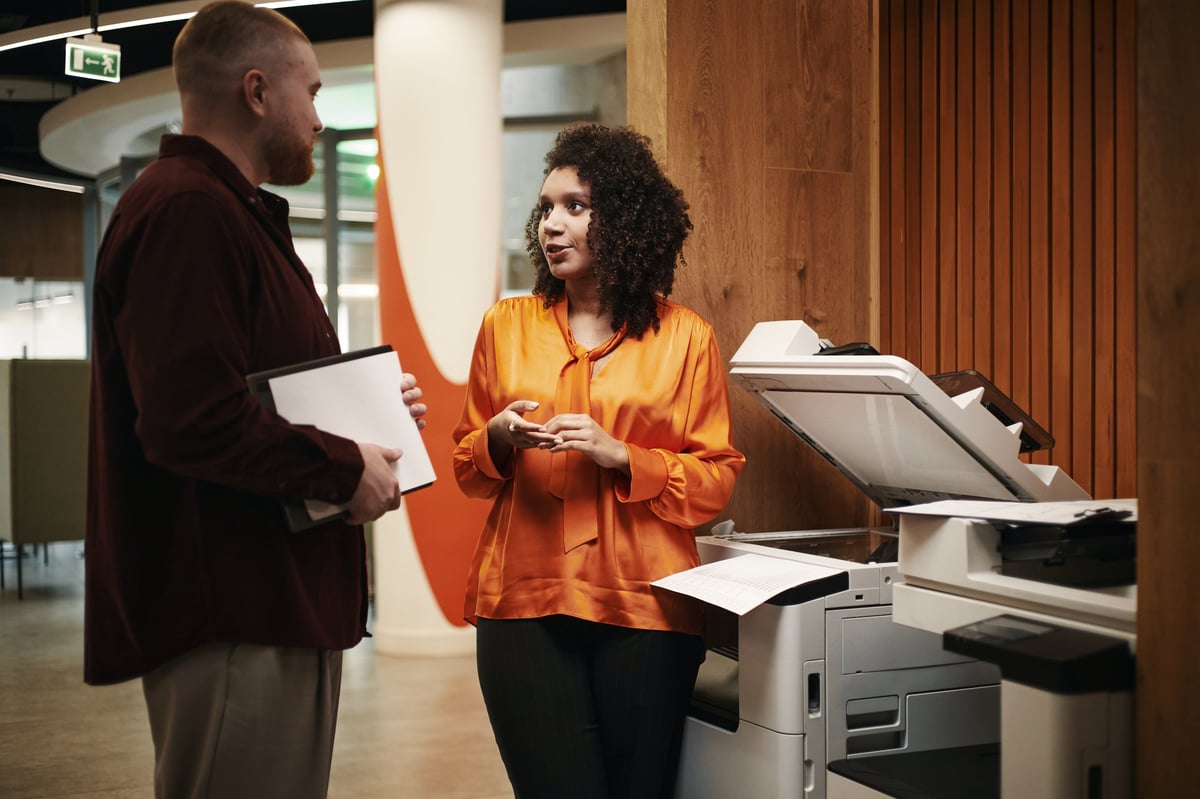
Proactive monitoring and support mean employees spend less time troubleshooting office equipment.
Printer problems can be surprisingly disruptive.
An employee waiting for a document to print may only lose a few minutes. Multiply that across several employees and repeated incidents throughout the year, and the lost time becomes much more significant.
Managed print services can reduce this administrative burden by providing proactive monitoring and technical support.
Many modern systems can monitor devices remotely and identify issues such as low toner or equipment faults. This allows problems to be addressed before they become major disruptions.
For employees, the benefit is straightforward: they can spend less time trying to fix office equipment and more time doing their actual jobs.
Better Control of Toner and Supplies
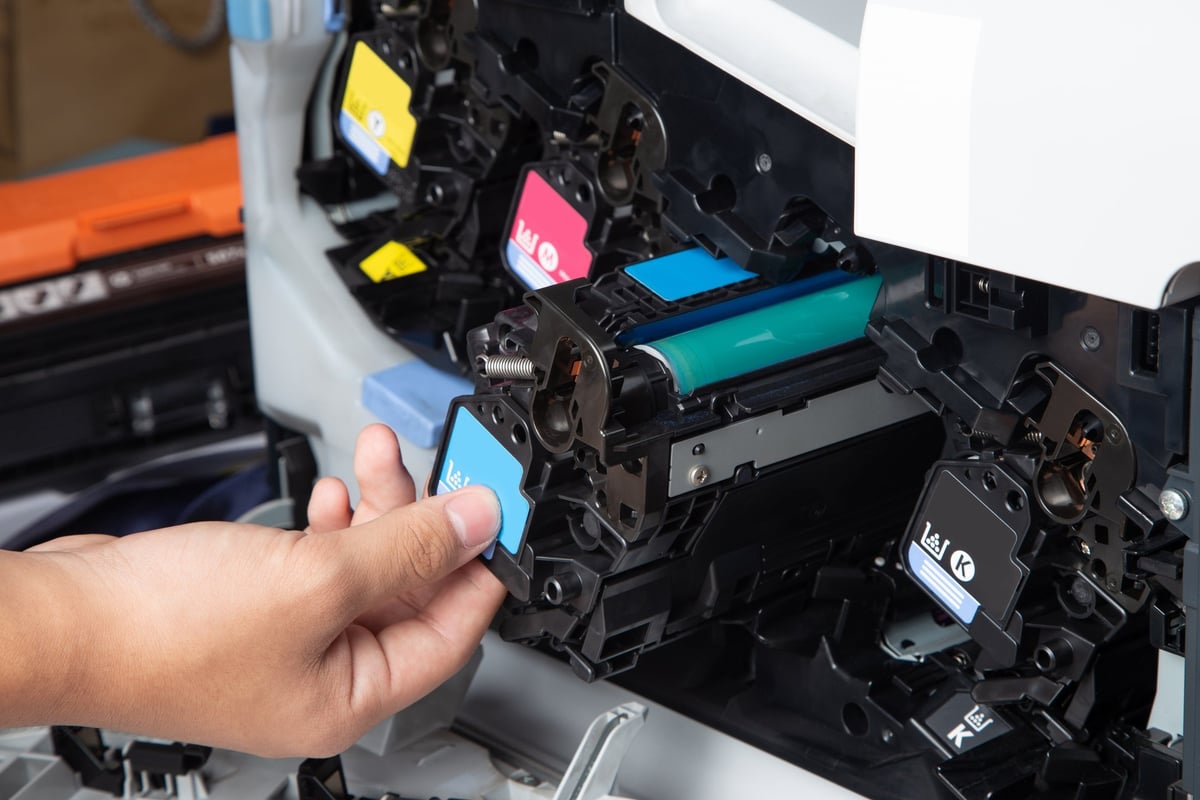
Automated toner monitoring keeps supplies topped up so important documents are never delayed.
Running out of toner at the wrong moment is an unnecessarily common office problem.
Someone discovers that the printer is almost empty, searches for the correct cartridge, places an order, and then waits for delivery. In the meantime, an important document may be delayed.
Managed print services can automate much of this process.
Devices can be monitored remotely so that toner levels are identified before they become a problem. Depending on the agreement, replacement supplies can then be delivered automatically.
This removes one more routine administrative task from employees and office managers.
Choosing the Right Equipment
Not every business needs the same printing setup.
A small professional services firm in Windsor may have very different requirements from a manufacturing business in Slough. A school in Maidenhead will have different printing patterns again.
One of the advantages of managed print is that equipment can be selected based on actual requirements rather than assumptions. That's why we recommend starting with a free managed print assessment to map your current setup before committing to new hardware.
A business may need fewer printers but higher-capacity multifunction devices. Another may benefit from smaller departmental machines. Some organisations may need advanced scanning capabilities, while others require strong document security.
The aim is to create a print environment that fits the business rather than forcing the business to adapt to its equipment.
Improving Document Security
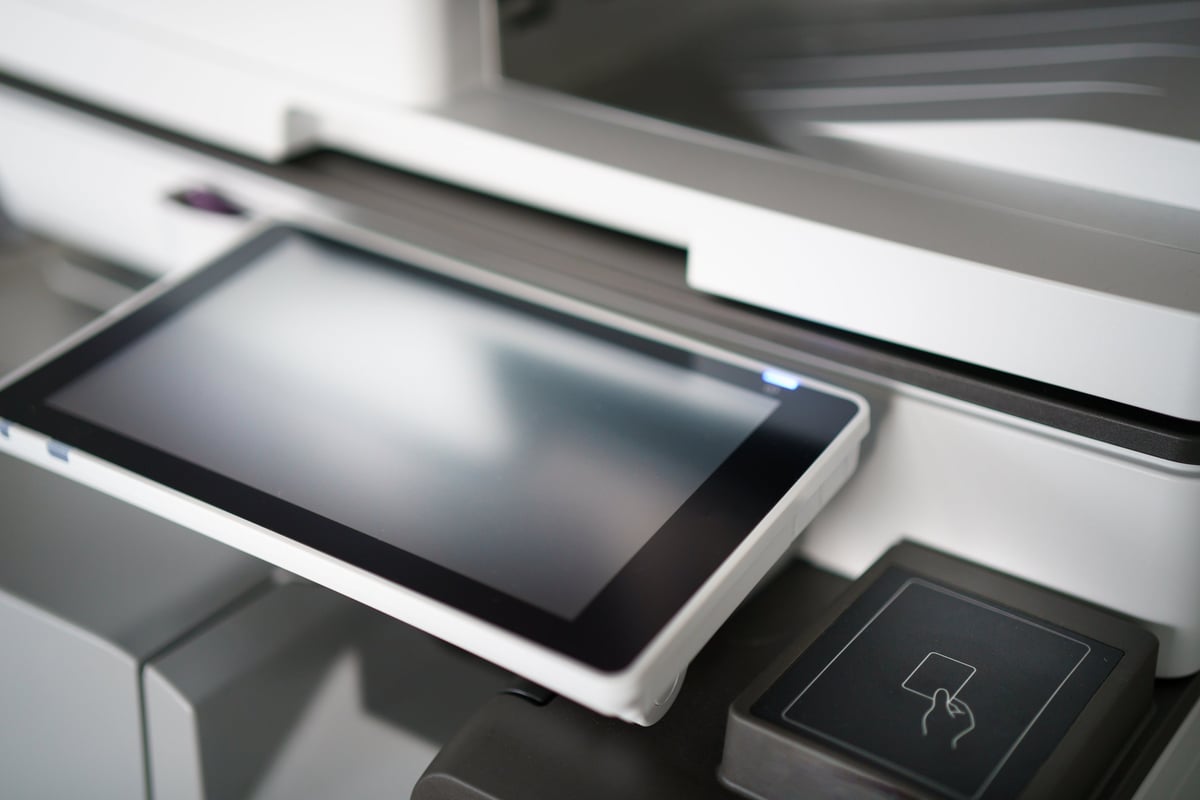
Secure release printing keeps confidential documents waiting behind a PIN or card rather than in an open paper tray.
Printers and multifunction devices are often overlooked when businesses consider cybersecurity.
Yet modern office printers can store documents, connect to company networks, and communicate with cloud services. An unsecured device can therefore create a potential weakness in an organisation's information environment.
Managed print can introduce additional security measures, including user authentication and secure release printing.
For example, instead of a confidential document immediately appearing in a shared printer tray, an employee can send the document to the device and release it using a PIN, card, or other authentication method.
This can be particularly valuable for businesses handling sensitive customer, financial, legal, or employee information.
Supporting Hybrid and Flexible Working

Modern managed print connects office devices with cloud services to support hybrid and flexible working.
The way people work has changed significantly.
Many Berkshire businesses now operate with a combination of office-based, remote, and hybrid employees. This creates new challenges for document management.
Employees may need to print from different locations or scan documents into digital systems rather than simply distributing paper internally.
Modern managed print solutions can support these workflows by connecting multifunction devices with digital document platforms and cloud services.
The result is a more flexible approach to printing and scanning, without relying entirely on traditional paper-based processes.
Why Local Support Matters
For businesses in Slough, Windsor, and Maidenhead, local support can be an important consideration.
When a critical office device stops working, waiting several days for assistance is rarely practical. A local managed print provider may be able to provide faster support and a better understanding of the businesses and organisations operating in the area.
Local knowledge can also be useful when recommending equipment. Print requirements vary considerably between industries, office sizes, and working environments.
A good managed print provider should therefore do more than supply a printer. It should understand how the organisation works and identify where its existing print setup can be improved.
Is Managed Print Right for Every Business?

Looking at the total cost of your current setup — not just hardware and toner — is the best way to decide if managed print is right for you.
Not necessarily.
A very small business with minimal printing requirements may not need a comprehensive managed print agreement.
For organisations with multiple printers, regular document production, high printing volumes, or recurring equipment problems, however, the potential benefits become more significant.
The best way to determine whether managed print makes sense is to look at the total cost of the current setup.
That means considering not only equipment and toner, but also maintenance, repairs, staff time, energy consumption, downtime, and document security.
A More Practical Approach to Office Printing
Printing may not be the most exciting part of running a business, but it is an area where small inefficiencies can become expensive over time.
For businesses across Berkshire, managed print offers a more structured way to deal with those inefficiencies.
By monitoring usage, managing equipment, controlling consumables, improving security, and providing technical support, businesses can gain a clearer understanding of what their printing actually costs.
For companies in Slough, Windsor, and Maidenhead, the decision to move to managed print is ultimately less about buying better printers and more about managing an important business process properly.
The printer itself is only one part of the equation. The real opportunity lies in understanding how information moves through the organisation and making that process as efficient, secure, and cost-effective as possible.
For Berkshire businesses looking to reduce unnecessary expenditure and simplify their office technology, managed print is becoming an increasingly practical option.
Managed print is about controlling costs — not just the printer.
For businesses across Berkshire, looking at the whole printing process — equipment, toner, support, and security — makes it easier to control costs and keep things running. If you'd like to understand what your current printing really costs, explore our managed print solutions or speak to our team about a free assessment.