
If you have spent any time trying to work out what a photocopier rental should cost, you will know how frustrating it can be. Most suppliers hide their prices behind a quote form, and the figures you do find online were written years ago and bear no resemblance to what you are being asked to pay today.
I have been pricing and supplying office copiers for more than twenty years, and I have watched rental costs move with paper prices, shipping costs, and the technology inside the machines. What follows is a straight answer to the question most people are quietly asking: what should I actually expect to pay in 2026?
I will take you through real monthly figures by machine size, explain what sits inside a rental price and what does not, and flag the extras that catch people out. No sales talk, just the numbers and the reasoning behind them.
What a Photocopier Rental Costs in 2026
Rental prices in the UK are usually quoted as a monthly figure for the machine, with the cost of printing charged separately as a rate per page. That split is important, because a low monthly number paired with a high page rate is not a cheap deal at all.
These are the ranges I would expect to see quoted to a UK business in 2026 on a three-year photocopier rental agreement, including a standard service and consumables bundle. Prices sit lower if you rent several machines together and higher if you want the newest model on the day it launches.
| Machine type | Best suited to | Monthly rental | Page rate |
|---|---|---|---|
| Desktop multifunction | 1 to 3 people | £25 to £45 | 0.9p mono / 4.5p colour |
| Entry level office copier | 4 to 10 people | £45 to £80 | 0.7p mono / 3.8p colour |
| Mid volume workgroup | 10 to 25 people | £80 to £150 | 0.6p mono / 3.2p colour |
| High volume department | 25 to 75 people | £150 to £280 | 0.5p mono / 2.8p colour |
| Production light | Print rooms | £280 to £550 | 0.4p mono / 2.2p colour |
To put that into context, a ten-person office printing around 3,000 black and white pages and 500 colour pages a month would typically pay somewhere near £91 a month in total: roughly £75 for the machine and service, plus about £21 in printing. A fifty-person office pushing 15,000 mono pages and 2,000 colour pages is looking at more like £215 a month once everything is counted.
You can see why the page rate matters as much as the headline rental figure. A machine at £60 a month on a 1.2p mono rate costs more to run than one at £80 a month on a 0.6p rate for anything above a light workload.
What Actually Drives the Price
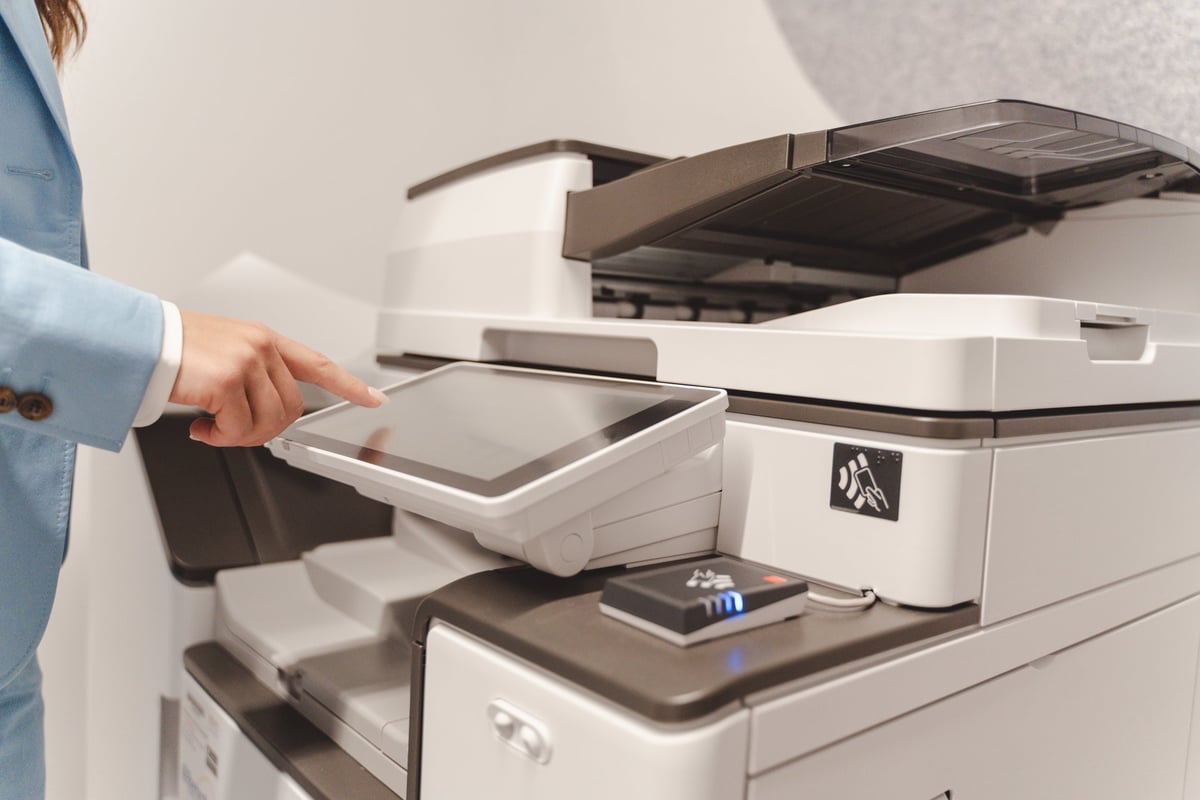
The specification inside the machine, not the badge on the front, is what moves the monthly figure up or down.
When two suppliers quote you wildly different prices for what sounds like the same copier, it usually comes down to one of these five things.
Print speed
Speed is measured in pages per minute, and it is the single biggest price driver. A 30 page per minute machine and a 60 page per minute machine do not cost twice as much by accident. Faster engines use heavier components, larger paper handling, and stronger motors. If your office prints in short bursts and nobody queues at the copier, paying for speed you never use is wasted money.
Paper capacity and finishing
Extra paper trays, a high capacity feeder, stapling, hole punching, booklet making, and folding units all add to the monthly figure. A basic copier holds 500 sheets and does nothing clever. A finisher unit alone can add £25 to £60 a month. Only pay for finishing if staff are genuinely spending time at the copier stapling and sorting by hand.
Colour or mono
Colour machines cost more to rent and considerably more to run. If the vast majority of your printing is black and white, a colour machine still makes sense for the occasional branded document, but the page rate should reflect that most of your volume runs in mono.
Term length
A three-year agreement carries a noticeably higher monthly payment than a five-year one because the cost of the hardware is spread over fewer months. That lower five-year figure is real, but so is being tied to the same machine well past its best. For most small and medium businesses, three years is the sensible balance.
Service agreement
A four hour service response time with all parts and labour covered costs more than a next day call out with exclusions. If your office cannot function without the copier, the faster cover is worth it. If a day without printing would barely register, take the cheaper cover and save the difference.
A quick way to sanity check a quote.
Multiply the monthly rental by 36, then add your expected monthly page counts multiplied by the page rates. Compare that total across quotes rather than comparing the monthly figures. Two suppliers quoting £80 a month can end up £900 apart over three years.
What Should Be Inside the Price
The whole point of renting rather than buying is that one predictable payment covers the machine and the things that keep it running. A well put together rental agreement should include the following without you having to negotiate each item separately.
Typically Included
- The photocopier itself, with delivery and installation.
- All toner, drums, and fuser units for the life of the agreement.
- Routine servicing and preventative maintenance.
- Parts and labour for engineer visits.
- Telephone and remote support during working hours.
- A guaranteed service response time.
- A set allowance of pages each month at the agreed rate.
Often Charged On Top
- ✕Pages above your monthly allowance, at the overage rate.
- ✕Staple cartridges, waste toner bottles, and special media.
- ✕Accidental damage or spill repairs.
- ✕Software licences for print management or document scanning.
- ✕Network setup and IT configuration beyond basic connection.
- ✕Collection of the machine when the agreement ends.
The distinction matters because a quote that looks expensive may include everything while a cheaper looking one adds maintenance as a separate line. Ask each supplier for the same written breakdown and compare them side by side. A fair floor for a genuine all-inclusive rental is around £1.20 to £1.60 per person in the office per week. If a quote comes in far below that, something has been left out.
The Extras That Push Your Price Up

Most of the surprise on a copier bill comes from items that were never mentioned in the quote.
Everyone quotes the monthly rental. Far fewer talk about what happens when volumes change, when the agreement ends, or when the machine takes a knock. These are the charges I see businesses caught by most often.
- ⚠Excess page charges. The most common surprise of all. If your monthly allowance is set too low, every page above it is charged at the overage rate. A busy month can add £30 to £80 to a bill in one go. Give the supplier a realistic volume from the start rather than an optimistic one.
- ⚠Annual price increases. Many agreements include a yearly uplift linked to inflation. At 4% a year, a £90 payment becomes £105 by the end of a three-year term. Ask whether the increase is capped and whether it applies to the page rate as well as the rental.
- ⚠Collection at the end. Some agreements bill £80 to £200 to collect the machine when you hand it back. It should be a one line answer: who pays for collection, and how much.
- ⚠Damage beyond fair wear and tear. A cracked panel, a liquid spill, or a dent from moving the machine falls outside normal use. Repairs of that kind are usually billed at full cost, so check your office insurance covers equipment in the same way it covers laptops.
- ⚠Delivery and setup. Most reputable suppliers include this, but not all. A £150 delivery charge on a low volume machine is a meaningful chunk of the first year.
- ⚠Software and print management. If you need visibility of who is printing what, or a secure release system, that software is normally licensed separately. Get the licence cost in writing alongside the rental quote.
None of these are unreasonable charges in themselves. The problem is only ever that they were not discussed. A supplier who is happy to put all six in writing before you sign is a supplier worth dealing with.
Renting Against Buying and Leasing
Price only means something next to the alternatives. Here is how the three routes sit against each other once you look past the first invoice.
Buying outright
£1,800 to £9,000 upfront
- The machine is yours from day one.
- Every repair, part, and cartridge is your cost.
- Value drops sharply in the first two years.
- Replacing it means finding the money again.
Leasing
£40 to £250 a month for 3 to 5 years
- Lower monthly figure than a short rental.
- You are committed for the full term.
- Ending early can cost most of what is left.
- The machine ages while you keep paying.
Renting
£25 to £550 a month for 3 years
- Machine, service, and toner in one payment.
- Swap or return with a couple of months notice.
- No upfront outlay and no repair bills.
- Upgrade when newer technology suits you.
The argument for buying is simple if you print heavily and intend to keep the machine for a decade. Most offices do not work that way. Equipment improves, teams move, contracts come and go, and a copier bought outright in 2026 will feel dated by 2030 with no obvious way out.
Leasing and renting look similar on a quote sheet, and that is where people get caught. A lease is a financial commitment you cannot easily undo. A rental is a service you can adjust. If you are weighing the two up, our guide to photocopier rental and buying walks through the numbers in more detail.
Ways to Keep the Cost Down
Rental prices are not fixed, and the businesses that pay the least are rarely the ones with the most negotiating nerve. They are the ones who have done the groundwork. Here is what actually moves the number.
Measure your real print volume first
Pull three months of meter readings before you speak to anyone. Suppliers price on volume, and a business that guesses high pays for capacity it never uses, while one that guesses low gets stung by overage charges. Real numbers are your strongest negotiating position.
Set the allowance slightly below your average
Allowances cost money. If you consistently print 2,400 pages a month, an allowance of 3,000 means you are renting headroom you rarely touch. A 2,500 allowance with a sensible overage rate is usually the better balance.
Ask for a three-year term, then compare it to five
Get both figures in writing. The five-year payment will be lower, and it is worth seeing by how much. If the difference is small, take the shorter term and keep your flexibility for the price of a few pounds a month.
Only pay for finishing you will use
Stapling, booklet making, and folding are the fastest way to inflate a quote. If your team staples a handful of documents a week, a finisher is an expensive way to save thirty seconds.
Consider a refurbished machine
A professionally refurbished copier from a reputable supplier can cost 30% to 40% less per month than the equivalent new model, with the same service cover. For a busy office where output quality matters more than having the newest model, it is often the smartest buy on the sheet.
Bundle your machines
If you have several offices or a mix of printers and copiers, a single managed print services arrangement across the whole estate almost always beats individual rentals. Suppliers will compete harder for the larger contract.
Ask what the price would be on a two-year term
It is worth knowing the cost of flexibility. If the jump from three years to two is small, buying yourself a year of options may be the best value item in the whole quote.
What You Should Get at Each Price Point
Under £50 a month
At this level you are looking at a desktop machine for a small team. Expect around 25 to 30 pages a minute, a single 250 sheet tray, scanning to email and cloud folders, and a modest page allowance. It is perfectly capable for a professional office that prints a few hundred pages a week. Where it will struggle is volume: push it hard and the running costs and the reliability both suffer.
£50 to £100 a month
This is the sweet spot for most small and medium offices. You get a freestanding copier running at 35 to 45 pages a minute, two paper trays holding around 1,000 sheets, fast duplex scanning, and a stronger service agreement. It will comfortably serve ten to fifteen people without anyone waiting. If your business has no fixed plans for significant growth, this bracket usually delivers the best value in the whole range.
£100 to £250 a month
A workgroup machine at this price runs 50 to 70 pages a minute with high capacity paper feeding, more advanced finishing, and secure release printing so staff authenticate before documents print. This suits busy departments where the copier is genuinely a shared production tool rather than an occasional convenience.
£250 a month and above
Light production equipment. These machines handle heavy monthly volumes, run 80 pages a minute and upwards, and offer professional finishing including booklet making and trimming. If you are paying this much for a machine in a normal office, ask whether the specification genuinely matches your volume or whether you have been sold more copier than you need.
Manufacturers to weigh up at each level include Canon imageRUNNER and imagePRESS, Ricoh IM series, Konica Minolta bizhub, Sharp BP series, and Kyocera TASKalfa. Every one of them makes good machines and every one makes a model that is slightly wrong for your office. The specification matters more than the name on the front.
The Page Rate Matters More Than the Rental
This is the part of the quote most people skim past, and it is usually where the money is. The rental is a fixed number you can see. The page rate is a small number that multiplies by everything your office prints.
A typical all-inclusive rate in 2026 runs between 0.4p and 1.0p for a black and white page and between 2.2p and 5p for colour. Those look like rounding errors until you apply them to real volumes.
| Monthly volume | At 0.5p mono | At 0.9p mono |
|---|---|---|
| 1,500 pages | £7.50 | £13.50 |
| 5,000 pages | £25.00 | £45.00 |
| 12,000 pages | £60.00 | £108.00 |
| 25,000 pages | £125.00 | £225.00 |
At 5,000 pages a month the difference between a good rate and a poor one is £20 a month, or £720 over a three-year agreement. That is more than most people negotiate off the rental. If you are going to push on one number, push on this one.
Two things to watch. First, check whether the rate changes once you pass your allowance, because overage rates are frequently higher than the included rate. Second, ask whether the rate is fixed for the whole term or subject to an annual rise. A page rate that climbs 5% a year on a high volume machine quietly costs more than any rental increase.
Questions to Ask Before You Agree a Price
Print this list and take it to your next supplier conversation. Any provider worth renting from will answer all of these without hesitation. The one who gets evasive on question four has told you what you need to know.
Frequently Asked Questions
A desktop machine for a small team starts around £25 a month. A freestanding office copier for ten to fifteen people sits between £50 and £100. Busy departments run £100 to £250, and light production equipment goes above £250. On top of the rental you pay a page rate of roughly 0.5p to 1p for black and white and 2.5p to 5p for colour.
In monthly terms, yes, and by a wide margin. Buying a mid range office copier outright means £3,000 to £5,000 upfront plus every service call and cartridge afterwards. Renting spreads that cost across a fixed monthly payment that already includes maintenance and consumables. Renting only works out more expensive if you keep the same machine running reliably for many years, which is rare in practice.
For an all-inclusive agreement in 2026, anything between 0.4p and 0.8p for a black and white page is competitive. Colour sits between 2.2p and 4.5p. Rates above 1p mono are hard to justify on a reasonable volume. If you print heavily, push hardest on the page rate because that is where the largest savings sit over a three-year term.
On a properly put together all-inclusive rental, yes. The monthly payment and page rate between them cover the machine, delivery, installation, all toner and parts, engineer visits, and labour. Where it gets murky is staples, waste toner bottles, print management software, and damage repairs, which are often charged separately. Get the inclusions listed in writing.
Three years is the most common term for UK office rentals, and it is the balance most businesses should aim for. Two year terms are available at a higher monthly cost, and five year terms bring the payment down but keep you tied to the same machine for longer than most offices want.
It depends on the contract. Many agreements include an annual increase linked to inflation, typically 3% to 5%. Over three years that can add more than 10% to your payment. Ask specifically whether the rental, the page rate, or both are subject to annual increases, and whether any cap applies.
Short term rental is available for events, temporary offices, and projects, but the monthly cost is higher than on a three-year agreement because the supplier has to recover the equipment cost quickly. If your need is genuinely short term, our guide to <Link to="/short-term-photocopier-rental-uk-guide" className="text-[#bf3644] font-semibold hover:text-black transition-colors no-underline">short term photocopier rental in the UK</Link> covers what to expect.
You pay an overage rate for every page above the allowance, and that rate is often slightly higher than your included rate. The fix is to agree a realistic allowance based on real meter readings rather than a guess. If your volumes are genuinely unpredictable, ask about an agreement that pools pages across several machines.
Often, yes. A professionally refurbished copier from a supplier who replaces worn parts and provides full service cover typically rents for 30% to 40% less than the equivalent new model. The output quality is generally indistinguishable in normal office use. What matters is that the service agreement is identical to the one on a new machine.
On most reputable rentals, no. Delivery, installation, and network connection are included in the monthly payment. It is worth confirming in writing anyway, because a £150 delivery charge on a low volume machine is a real addition to your first year of cost.
Agree a three-year term rather than a shorter one, take a refurbished model if the newest equipment is not essential, set the page allowance just below your average volume, skip finishing options you will not use, and bundle machines across offices into a single contract. Between them those choices can reduce the monthly cost by a third without any drop in service quality.
Work out the total cost of ownership over the full term: monthly rental multiplied by the number of months, plus your expected monthly print volume multiplied by the page rates. Do this for every quote using the same volume figures. Then compare what is included and what is excluded. The lowest monthly figure is very often not the cheapest agreement.
Getting a Fair Price on Your Copier
Photocopier rental pricing in the UK is not as mysterious as the industry makes it look. The monthly figure is driven by speed, paper handling, colour, term length, and the level of service cover. The page rate is what your actual cost turns on. Get both in writing, compare them on the same volume, and the difference between a fair deal and a poor one becomes obvious.
The businesses that pay too much are almost never the ones who negotiated badly. They are the ones who compared monthly payments instead of total costs, accepted an allowance they never checked, and did not ask what happens at the end of the term. Every one of those mistakes is avoidable with one honest conversation before you sign.
If you would like a straightforward quote with the numbers laid out properly, get in touch with our team. We have been supplying and servicing photocopiers since 1985, and we are happy to talk through what your office actually needs before anyone mentions a price.